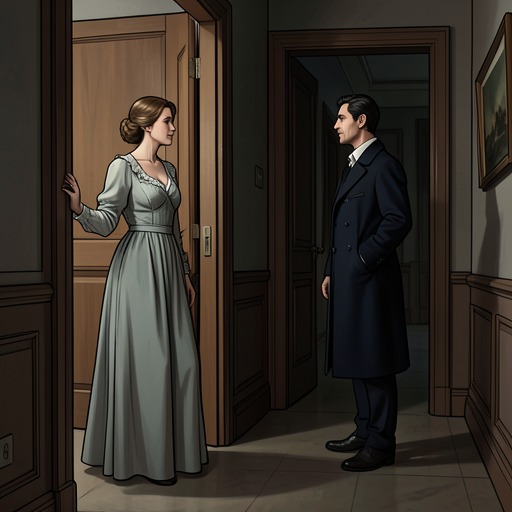
Gray Drug Store Robbery
The Minds of Billy MilliganThe Gray Drug Store Robbery is a planned armed theft whose apparent division of labor conceals a second crime: Kevin arranges for Wayne Luft and Roy Bailey to rob the store, then leaves them unconscious and takes the proceeds alone. Its decisive turn comes when the robbery’s supposed planner mistakes the absence of a direct link for safety; a fence’s report about the stolen drugs ultimately leads to a warrant for Billy Milligan’s arrest.
The Delivery and the Plan
On Wednesday, January 8, Tommy was having lunch with Marlene at the Memorial Plaza Shopping Center when he saw a delivery van pull up to the Gray Drug Store. As the delivery man carried a large box inside, Tommy remarked that it was a narcotics delivery and that the pharmacist would be working late. Marlene looked at him curiously. Tommy himself did not know why he had said it. The moment places the robbery’s target in view before its execution, while making Tommy’s knowledge an unsettling fact that neither he nor Marlene can explain at the time.
Kevin, meanwhile, had already planned to rob the store. He recruited Wayne Luft and Roy Bailey, assigning them the work of carrying out the robbery while promising that they would receive most of the money and drugs. Kevin expected 20 percent for arranging the job. The division looked like a practical agreement, but it also positioned Kevin to benefit without being among the men who would enter the store. The contrast between the apparent partners’ roles and Kevin’s actual plan becomes central to the event’s outcome.
The Armed Robbery
At one-thirty in the morning, Luft and Bailey followed Kevin’s instructions. They forced the pharmacist back into the store at gunpoint, then robbed the safe and the narcotics cabinet. The pharmacist was therefore directly confronted by the two men who carried out the robbery, while Kevin remained outside the store’s immediate scene. That separation would later underpin his belief that investigators could not connect him to the crime.
Afterward, the men drove into the woods. They spray-painted their white Dodge station wagon black and then drove to pick Kevin up. At Bailey’s place, Kevin examined the drugs taken from the cabinet, including Ritalin, Preludin, Demerol, Seconal, Quaalude, and Delaudid. He estimated that the drugs could bring thirty to thirty-five thousand dollars on the street. The transformed car and the inventory of narcotics show the operation moving from the forced entry at the store to the handling and prospective sale of its proceeds.
The Partnership Turns on Itself
As the night wore on, the men got high. The promised division of spoils did not hold: Luft and Bailey each approached Kevin privately with the suggestion that the two of them should join forces to rob the third partner. Their proposals turned the arrangement’s underlying distrust into an immediate contest over who would control the money and drugs. Kevin, already aware of their fear of him, did not wait for either proposal to become action.
By morning, Bailey and Luft were unconscious. Kevin put the money and drugs into two suitcases and left for Columbus alone. He judged that neither man would have the nerve to stand up to him, a confidence reinforced by their repeated talk about how crazy he was. They had discussed his having put his fist through a door and used a Thompson machine gun to shoot up a man’s car. The robbery’s planned partnership thus ends not in a shared division of the proceeds but in Kevin’s unilateral escape with the entire cache.
A False Sense of Distance
Kevin expected Luft and Bailey to inform the police, but believed a tip would not be enough to implicate him. In his calculation, the pharmacist had seen the two robbers, not Kevin; once Kevin had disposed of the drugs, he assumed there would be nothing to connect him to the store. His apparent protection rested on a distinction between planning a robbery and physically entering the premises. The account exposes the weakness in that distinction: the stolen narcotics could still be traced after the men who took them had left the store.
The next day, Marlene read about the Gray Drug Store robbery in the Lancaster Eagle-Gazette and felt a sinking apprehension. Her reaction followed Tommy’s inexplicable remark about the delivery and the pharmacist’s late shift. She suspected that Tommy had been involved, although he had not understood why he had recognized the shipment. The newspaper report therefore turns the earlier lunch-table exchange into a warning, without resolving the gap between Tommy’s observation and Kevin’s plan.
The Inquiry and the Warrant
After Tommy told Arthur about Marlene’s suspicions and his earlier observation of the drug shipment, Arthur questioned the people inside. Kevin admitted that he had planned the robbery, while maintaining that he had not been there: he said he had arranged it and then robbed the two men who carried it out. He called the operation a sting and believed the police could not tie him to the store. Arthur then asked Allen and Ragen whether there was anything that could connect them to an arrest; as far as they knew, there was not. Kevin’s confession within the group and his confidence about the external evidence thus coexist with the assumption that no usable link exists.
Several days later, that assumption failed. A Columbus fence who owed a narcotics detective a favor reported that Milligan had sold him drugs matching the description of those stolen from the Gray Drug Store. The information reached the Lancaster police department, and a warrant was issued for Billy Milligan’s arrest. The report does not describe an arrest taking place at that moment, but it establishes the consequence of the attempted concealment: Kevin’s decision to take the drugs alone gave investigators a route from the stolen property back to Milligan. The event’s final reversal is not an eyewitness identification of the planner, but the circulation of the narcotics he believed he could dispose of without consequence.